Ethereum vs. Solana: Analyzing Potential Percentage Gains for 2027 Amidst Market Uncertainty
Published
As of mid-November 2026, both Ethereum (ETH) and Solana (SOL) are trading significantly below their previous peaks, prompting an analysis of their potential for larger percentage gains by 2027.
MissedBlock Desk · 4 min read
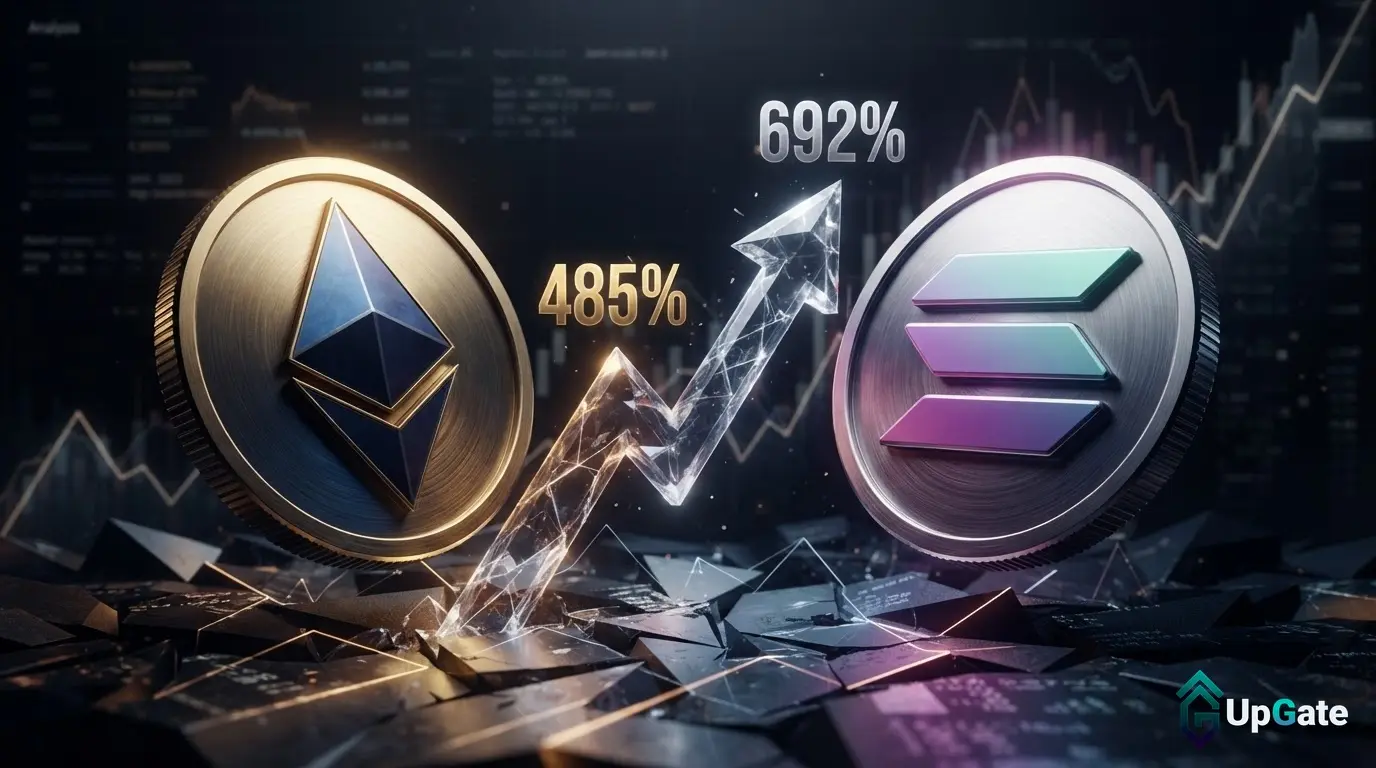
As of mid-November 2026, both Ethereum (ETH) and Solana (SOL) are trading significantly below their previous peaks, prompting an analysis of their potential for larger percentage gains by 2027. While Ethereum holds advantages in institutional depth and lower relative risk, Solana is positioned by some analyses, including a prediction attributed to Elon Musk’s Grok AI, for greater upside potential due to its higher beta and clearer execution catalysts.
Current Market Snapshot
Currently, Ethereum is trading in the range of $1,780–$1,880 with a market capitalization of approximately $210–$230 billion. This places ETH roughly 63% below its August 2025 high of around $4,946. Technically, Ethereum is trading below key moving averages, including its 20-day, 50-day, and often its 200-day average, which hovers near $2,100–$2,150. Support levels are observed between $1,750–$2,000.
Solana, on the other hand, is trading between $65–$80 with a market cap of roughly $35–$45 billion. SOL is approximately 75% below its January 2025 peak of nearly $293. Solana is also trading below its 200-day moving average, recently cited near $89. Near-term support for Solana is seen in the $60–$70 range, with resistance at higher levels between $100–$140. Solana has demonstrated stronger rebound characteristics, including a notable ~64% bounce in August 2026.
Roadmap and Catalyst Assessment
Looking ahead, both networks have significant upgrades planned. Ethereum’s roadmap includes the Glamsterdam upgrade, featuring enshrined proposer-builder separation (ePBS) and block-level access lists, potentially increasing its gas limit to 200. The Hegotá upgrade is also targeted for 2027. However, the Glamsterdam upgrade might slip into early 2027.
Solana’s catalysts for growth include Firedancer, an independent validator client developed by Jump Crypto, and Alpenglow, a planned overhaul of its consensus mechanism. Alpenglow aims to reduce Solana’s target finality time to 150 milliseconds, a significant improvement from its current finality of approximately 12.8 seconds. Furthermore, the DTCC plans to connect its tokenization service to Solana in the second half of 2027, a development that could significantly boost institutional adoption.
Comparative Potential and Risks
According to Grok AI, Solana is positioned for larger percentage gains by 2027. This prediction is based on Solana’s higher beta and clearer execution catalysts. Solana’s smaller market capitalization, combined with its potential performance upgrades like Firedancer and Alpenglow, creates greater asymmetry for upside if market risk appetite returns and network activity expands. The DTCC integration further bolsters this outlook.
Conversely, Ethereum’s larger market cap and established institutional ownership base contribute to more muted rebounds. While Ethereum’s upgrades and potential growth in real-world asset (RWA) tokenization could lead to solid absolute returns, its maturity typically compresses percentage upside. Spot ETF flows provide a structural bid for Ethereum, supporting its stable institutional foundation.
Despite these factors, significant uncertainties remain for both cryptocurrencies. The exact timeline for Solana’s Alpenglow activation and the resolution of its network reliability questions are key considerations. For Ethereum, potential delays in the Glamsterdam upgrade could impact its development trajectory. Macroeconomic headwinds and ongoing competition also pose risks to both assets. Past performance and roadmaps are not guarantees of future results, and crypto markets remain highly uncertain. Investors should carefully weigh their risk tolerance when considering these potential investments.
Why This Matters
This analysis of Ethereum and Solana’s potential for percentage gains by 2027 is presented in the context of their current market positions, historical performance, and future roadmaps. The potential for Solana to achieve larger relative upside, driven by its higher beta and clearer execution catalysts, is a key point of consideration, alongside Ethereum’s advantages in institutional depth and lower relative risk. The uncertainty surrounding the timing of Ethereum’s Glamsterdam upgrade and Solana’s Alpenglow activation highlights the speculative nature of these projections.
Broader Context
The article analyzes the current market positions, historical performance, and future roadmaps of Ethereum and Solana to predict which cryptocurrency is likely to achieve greater percentage gains by 2027. This analysis is informed by data as of mid-November 2026, including technical indicators, planned upgrades, and potential institutional integrations like the DTCC’s planned connection to Solana in the second half of 2027. The prediction attributed to Grok AI is presented with caveats regarding market uncertainty and the speculative nature of future price movements.