Fast, Private USDT Coming to Bitcoin: Can it Challenge Ethereum and Tron?
MissedBlock Desk · · 5 min read
Updated
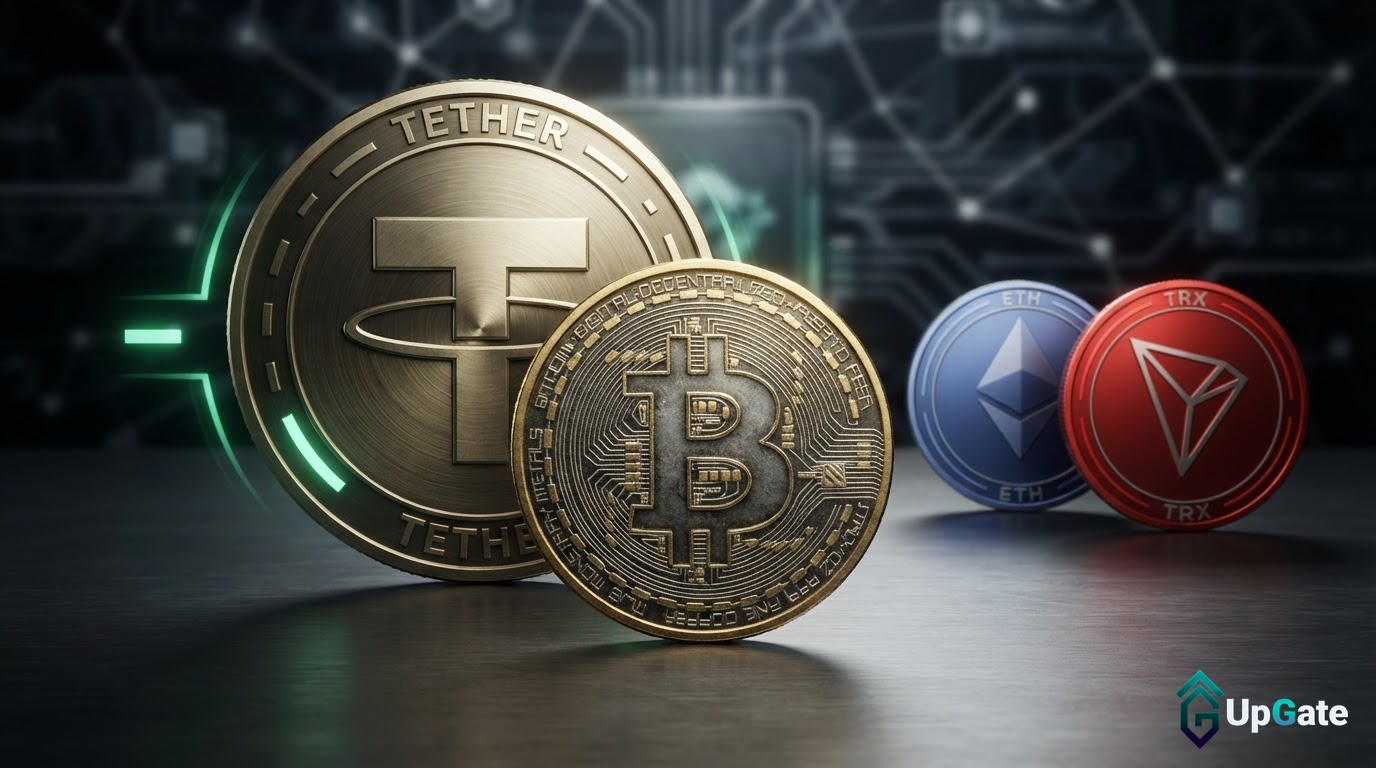
Tether Returns to Bitcoin with Focus on Privacy and Speed
Utexo, a Dubai-based blockchain startup, is preparing to reintroduce Tether’s dollar-backed stablecoin, USDT, to the Bitcoin network after a three-year absence. The integration will leverage the RGB protocol, which keeps asset transaction data off-chain, promising private and swift payments. A public launch is slated for November 28, with Lightning Network support anticipated in the first quarter of 2027.
This move raises questions about USDT’s ability to compete with established stablecoins on networks like Ethereum and Tron, which boast a combined supply of $300 billion and offer smart contract functionality and decentralized finance (DeFi) capabilities.
USDT’s history on Bitcoin dates back to 2014, when it was initially launched on the Omni protocol. However, Tether ceased issuance on Omni in August 2023, citing declining usage. While Tether had previously announced plans to launch USDT on RGB in August 2025, this did not materialize. Instead, Tether led Utexo’s $7.5 million seed round in March, and the new firm will now launch the Bitcoin version of the stablecoin using Tether’s USDT0 protocol.
The central question remains: if USDT’s previous iteration on Bitcoin proved unviable, why would it gain traction now? Viktor Ihnatiuk, co-founder and CEO of Utexo, attributes the potential resurgence to two key factors: speed and privacy. By utilizing Bitcoin as the settlement layer and RGB to keep transaction details off the public blockchain, Utexo aims to enable private and rapid transactions.
“You can actually achieve any speed you want to achieve,” Ihnatiuk stated. “Bitcoin is the best blockchain. Lightning is the best technology to scale payments.”
Utexo’s genesis lies in an initiative to bring dollar-denominated payments to Bitcoin, a concept that solidified after a discussion with Tether at Bitcoin Prague in 2023. The company is also building upon RGB and Lightning infrastructure developed by ThunderStack, founded by fellow Utexo co-founder Renat Skitsan.
The RGB protocol, under development since 2016, allows users to issue and transfer digital assets via contracts linked to Bitcoin without recording every transaction detail on its public ledger. Unlike protocols that aim to make Bitcoin function like Ethereum, RGB empowers parties to validate asset transactions themselves, with cryptographic commitments anchored to Bitcoin providing security. This positions RGB as a Bitcoin-native protocol, distinct from sidechains or rollups. Furthermore, RGB’s compatibility with the Lightning Network enables USDT to move through its payment channels without necessitating base-layer transactions for each transfer.
“Lightning allows you to do transactions with a dynamic of 100 milliseconds,” Ihnatiuk explained. “It’s faster than Solana, it’s faster than Monad, it’s faster than Sui or Aptos. The limitation is only in the brain of people who don’t understand how to scale Bitcoin.”
Bitcoin’s inherent transparency has been a barrier to broader business adoption, as many companies prefer to maintain confidentiality regarding their transactions. Ihnatiuk believes that by focusing on secure Bitcoin-based settlement and enhanced transaction privacy, rather than competing with networks like Tron on retail volume or Ethereum on DeFi, Utexo can entice businesses to adopt its solution. He also noted that Utexo can selectively disclose relevant transaction information for compliance purposes and has established procedures for responding to law enforcement requests.
Early Access and Bridging Mechanisms
Utexo initiated early access to its USDT Mint product on October 22, allowing verified professional operators, including exchanges, wallets, and market makers, to test minting, confidential transfers, and redemption on Bitcoin’s Signet test network. This testing phase is intended to provide operators with time to refine transaction flows and prepare for integrations ahead of the public launch.
The process of migrating existing USDT to Bitcoin via Utexo Mint involves an additional step: locking USDT0 on Arbitrum before minting an equivalent amount of USDT on Bitcoin. Users can redeem their tokens by burning the RGB asset, which then triggers the release of the corresponding funds on the source network.
Consequently, the security of Mint is contingent not only on Bitcoin and RGB but also on the mechanisms connecting these networks. Users must trust that the USDT0 locked on Arbitrum remains accessible and can be released upon redemption of their Bitcoin-based USDT. While this architecture aims to mitigate risks, the reliance on bridges introduces potential vulnerabilities, as they have historically been targets for hackers. Utexo has stated that Mint has undergone an audit by Oxorio, though the full report is not publicly available.
Utexo has announced UniSat as a launch partner, with plans to integrate USDT transfers and swaps into its wallet. Ihnatiuk also indicated that Utexo is collaborating with 12 over-the-counter network partners and has an additional 40 in its pipeline.
Future Prospects and Miner Benefits
Ihnatiuk envisions opportunities in Bitcoin-native trading and lending, but he emphasizes that Bitcoin will not replicate Ethereum’s DeFi ecosystem. Instead, its strengths lie in payments and simpler financial arrangements, such as escrow-based exchanges. “People who think that it’s possible to replicate Ethereum DeFi on Bitcoin make a huge mistake,” he asserted. “Bitcoin was never built for DeFi. Bitcoin was always built for payments.”
Another potential use case involves retaining miners on the Bitcoin network. By enabling miners to swap BTC for USDT directly on Bitcoin, rather than transferring funds to centralized exchanges, their exposure to custodial risk would be reduced, and hedging strategies could be more easily automated. “So, for miners, it’s quite beneficial,” Ihnatiuk commented.
Ihnatiuk has set ambitious targets for the first year, aiming for a minimum milestone of $1 billion USDT on the Bitcoin network within 12 months, with initial and median goals of $10 billion and $5 billion, respectively.
The increased adoption of USDT is also expected to benefit Bitcoin itself by boosting miner fee revenue. “Once USDT comes back to Bitcoin,” Ihnatiuk said, “you will get meaningful adoption; all the transactions will come to Bitcoin. So, yeah, miners will be able to make much more.”
Ultimately, whether Bitcoin can successfully compete with Ethereum, Tron, and other networks as a new home for USDT hinges on its ability to demonstrate a viable market this time around.