Infrastructure Gaps Drive Institutional Capital to Passive Crypto ETFs Over Active Hedge Funds
Published
Institutional capital is increasingly favoring passive cryptocurrency Exchange Traded Funds (ETFs) over active crypto hedge funds, a trend driven by significant gaps in institutional-grade distribution and reliable data verification, according to Binance Research.
MissedBlock Desk · 4 min read
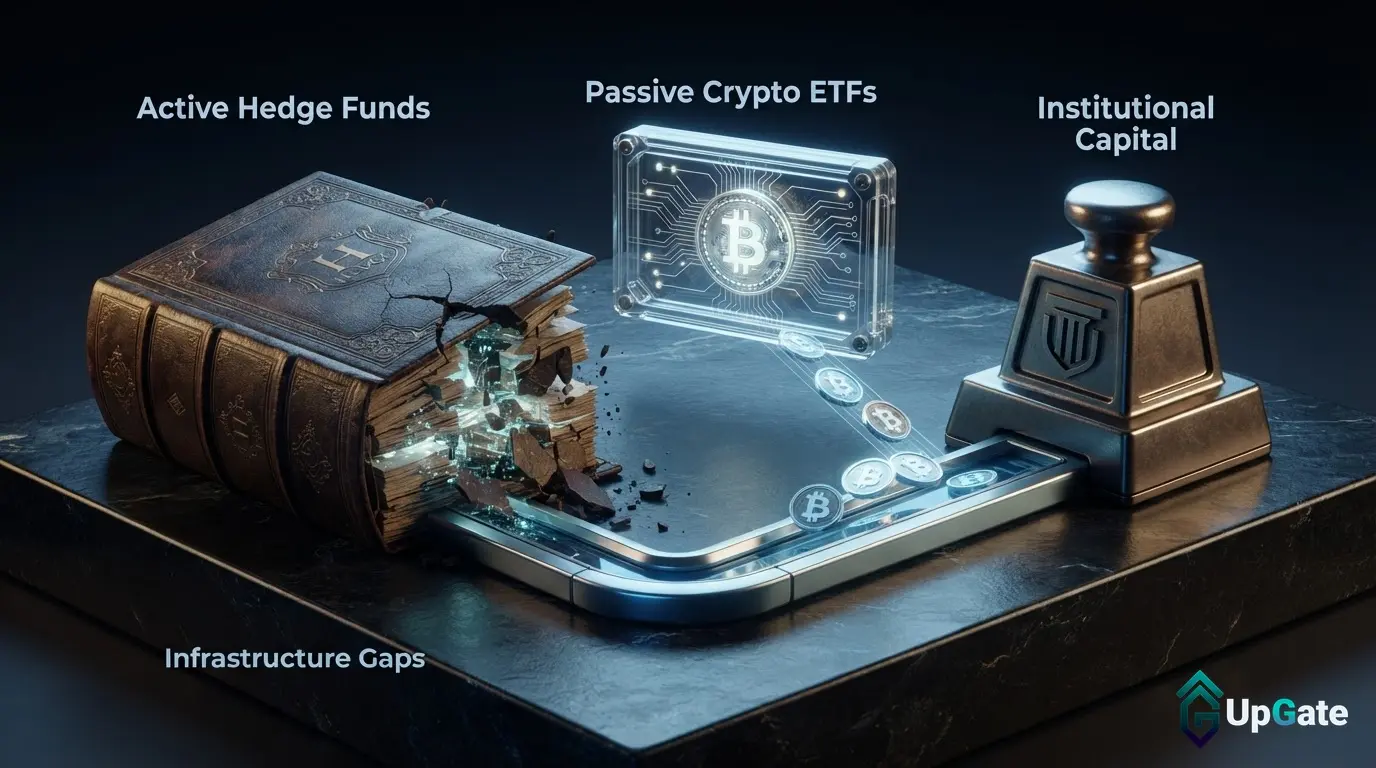
Institutional capital is increasingly favoring passive cryptocurrency Exchange Traded Funds (ETFs) over active crypto hedge funds, a trend driven by significant gaps in institutional-grade distribution and reliable data verification, according to Binance Research. This dynamic highlights a critical bottleneck in the crypto hedge fund industry, impacting capital allocation and underscoring the need for improved infrastructure to foster trust and accessibility for institutional investors.
The scale disparity is stark: US Bitcoin and Ethereum spot ETFs have amassed $111 billion in assets, projected to reach this figure by October 2026. In contrast, active crypto hedge funds average only $132 million in size, with a significant 91% managing less than $1 billion. This divergence suggests institutional investors are prioritizing asset safety, verifiable data, and compliant products for exposure, rather than the potential alpha from active management within the current crypto market infrastructure.
Binance Research points out that the primary obstacle for active funds is not their investment research capability, but the lack of institutional-grade distribution channels and reliable data verification processes. This infrastructure gap means that even funds with strong performance may struggle to attract capital. Indeed, 81% of surveyed institutions prefer to gain spot exposure through registered compliant products, a preference that passive ETFs currently fulfill more readily.
Institutional investors are increasingly prioritizing asset safety and verifiable data. According to Binance Research, 80% of surveyed allocators prioritize asset safety over historical performance and institutional reputation. Verified on-exchange real data is seen as crucial for enhancing due diligence credibility. Consequently, the true fundraising barrier for fund managers appears to be the cost of trust, as past performance is difficult to cross-verify, and issues related to Know Your Customer (KYC), Anti-Money Laundering (AML), and counterparty compliance checks severely slow down fundraising.
While passive vehicles dominate in terms of asset size, active strategies are still being explored. On the Capital Connect platform, directional strategy funds constitute 44.3% of the total funds but attract only 6.7% of the platform’s capital. Conversely, market-neutral, statistical arbitrage, and traditional finance-style multi-strategy funds collectively manage a substantial 92.1% of assets under management. This indicates a strong institutional inclination towards strategies with more predictable outcomes and lower volatility, even if directional strategies offer higher potential upside.
Despite market volatility, some active strategies are demonstrating resilience. In October, while Bitcoin fell 7.2%, directional funds recorded an average gain of +1.9%, and market-neutral funds averaged a +1.0% gain. Investor participation in market-neutral strategies has seen a 30% increase since May, and statistical arbitrage participation has more than doubled in the same period. The average yield for directional strategies since inception improved from -11% in June to +3.7% in October. However, the performance distribution for directional strategies remains wide, with the performance gap between the best and worst funds being approximately eight times that of neutral strategies. Nine out of ten market-neutral funds recorded positive returns in October, indicating a more consistent performance profile.
Binance Research indicates that the true fundraising barrier for fund managers is not insufficient returns, but the cost of trust. Past performance is difficult to cross-verify, and issues like KYC, AML, and counterparty compliance checks severely slow down fundraising. Most funds currently rely on personal recommendations for fundraising. The emergence of platforms has allowed some managers to reach a broader investor base, including compliant institutions, and pool smaller funds.
Uncertainties remain regarding the exact timeline for when institutional investors may overcome their hesitations regarding active crypto hedge funds and the specific improvements in distribution and data verification that would satisfy institutional requirements. The long-term sustainability of market-neutral and statistical arbitrage strategies compared to directional strategies, and the extent to which ‘verified on-exchange real data’ can be standardized and trusted by institutions, are also key questions for the future.
Why This Matters
The materials describe a narrow update: Despite a significant inflow of institutional capital into passive Bitcoin and Ethereum spot ETFs, active crypto hedge funds are struggling to attract similar levels of investment. The exact timeline for when institutional investors may overcome their hesitations regarding active crypto hedge funds.
Broader Context
Source materials place the market analysis in this context: US Bitcoin and Ethereum spot ETFs have reached an asset size of $111 billion.