Italian Car Rentals Used as Mafia Underground Banks; 30 Arrested in Crypto Laundering Bust
MissedBlock Desk · · 5 min read
Updated
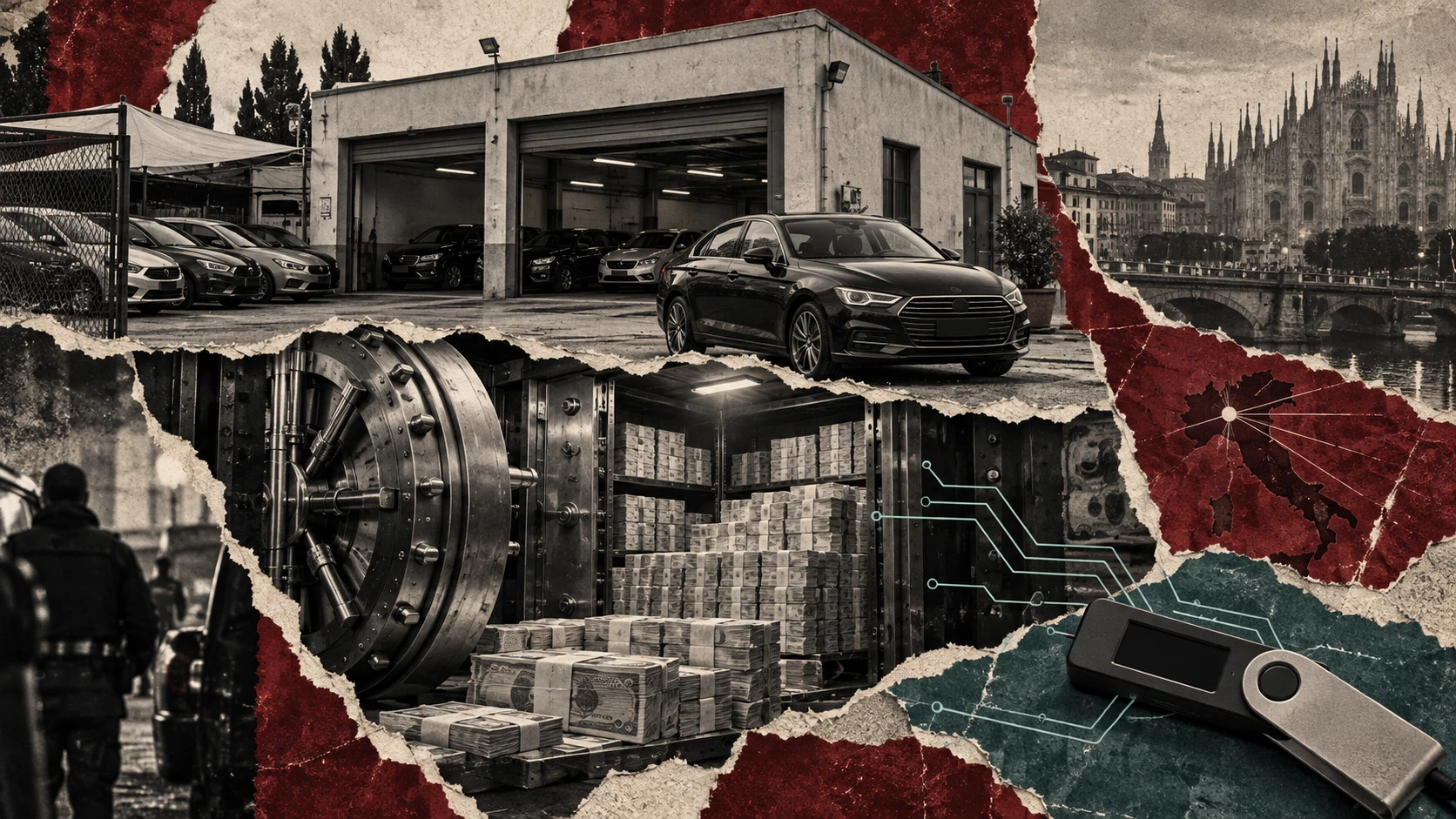
Mafia Clans Used Car Rental Firm as Underground Bank for Laundering Drug Money
Milan, Italy – Authorities have dismantled a sophisticated money laundering operation run by Italy’s most powerful mafia groups, the ‘Ndrangheta and Camorra, which allegedly used a car rental business near Milan as a front for an underground bank. Prosecutors claim the organization funneled illicit funds from drug trafficking and tax evasion into cryptocurrency through a complex web of fake invoices, cash refunds, and exchanges.
The Italian Financial Police seized assets worth €21 million (approximately $23.6 million) in a sweeping operation that also implicated corrupt police officers and court officials.
Operation Uncovers Vast Criminal Network
The sting, announced on October 21, 2026, targeted a car rental agency in Pero, a suburb of Milan. Investigators revealed it served as a shared financial hub for the ‘Ndrangheta and Camorra. The operation resulted in the arrest of 30 individuals, with assets including cash, bank deposits, cryptocurrencies, boats, jewelry, and luxury watches confiscated.
The Milan Public Prosecutor’s Anti-Mafia Directorate (DDA) led the investigation, deploying over 350 financial police officers across the country. Of the 30 suspects, 16 were taken into custody, and 14 placed under house arrest. Spanish authorities apprehended two individuals based on European arrest warrants, while one person remains at large in Switzerland. Bloomberg, citing Milan prosecutors, reported that the scheme involved over €110 million in fraudulent invoices, with approximately €68 million being transferred abroad.
Leadership and International Reach
According to information compiled by ilsud24, the car rental operation was managed by three Italians. Two were identified as long-term associates of ‘Ndrangheta families from Crotone, with prior convictions in the Infinito and Aemilia cases. The third individual was linked to the Casalesi clan. A ruling obtained by LaC News24 named the alleged ringleaders as Giuseppe Piscioneri, Paolo Pelaggi, and Luigi Mercadante. The operation, which had been running for approximately three years in the Lombardy region, also involved accomplices of Chinese and Albanian nationality.
Four-Stage Laundering Process
Prosecutors detailed a four-stage money laundering process. The first stage involved collecting cash, primarily from tax evasion, managed by two Chinese nationals. A man from the Calabria region, either personally or through intermediaries, delivered over €5 million in drug trafficking proceeds. This cash was then exchanged for an equivalent amount in cryptocurrency or wired to accounts in Asia, Canada, and South America.
Shell companies, registered under nominees and with fictitious addresses, were then utilized. These companies issued invoices for services never rendered to clients in the construction, logistics, and service sectors, allowing them to reduce their taxable income. Once their purpose was served, these companies would declare bankruptcy, only to be replaced by new entities managed by the same group. After clients paid these invoices via bank transfer, the organization would refund the equivalent cash through intermediaries, charging a commission of 2% to 5%.
The final stage involved cryptocurrency. Funds accumulated in the shell companies’ accounts were transferred to banks in Luxembourg, Lithuania, and Germany before being converted into cryptocurrency through exchanges and deposited into wallets controlled by the group. Proceeds from online cryptocurrency investment scams also followed this route.
Resilience and Corruption
Milan’s preliminary judge, Luca Milani, described the mechanism as having a “regenerative capacity” in his over 500-page detention order, which outlines nearly 90 charges. He noted its ability to persist through “always new methods, new companies.”
It is important to clarify that this case does not represent a mafia shift into cryptocurrency trading, but rather the role of digital assets within a broader money laundering chain. Cash, fake invoices, and bank transfers are traditional methods, with cryptocurrency serving as the final step for cross-border transfers to more untraceable destinations.
A particularly sensitive aspect of the investigation involves breaches within law enforcement and the judiciary. The ruling indicated that a financial police inspector is accused of accepting €3,000 in cash from a Chinese suspect who is now in custody. The inspector allegedly leaked confidential information related to tax evasion and offered to resolve issues between May and September 2025. This inspector is currently under house arrest.
Another line of inquiry leads to the Milan court. Prosecutors allege that a court employee, with the assistance of a lawyer, illegally accessed computer records to monitor investigation progress and reported findings to the organization’s leadership.
Mafia Ties and Influence
Wiretapped conversations provided insights into the organization’s connections. The ruling quotes a conversation from November 20, 2025, where Piscioneri boasted about his close ties to the Bellocco family, stating, “He has twelve brothers… I am the thirteenth.” Investigators interpret this as an indication of his perceived proximity to this ‘Ndrangheta clan.
Another suspect, Salvatore Morabito, linked to a family of the same name, is accused of frequenting the office in Pero and is also in custody. The ruling also notes that the suspects interacted with a circle that included law enforcement officers, lawyers, and administrative personnel, the nature and extent of which are still subject to court scrutiny.