SEC Veteran Tapped as AI Czar; Bitcoin Eyes $600K
MissedBlock Desk · · 8 min read
Updated
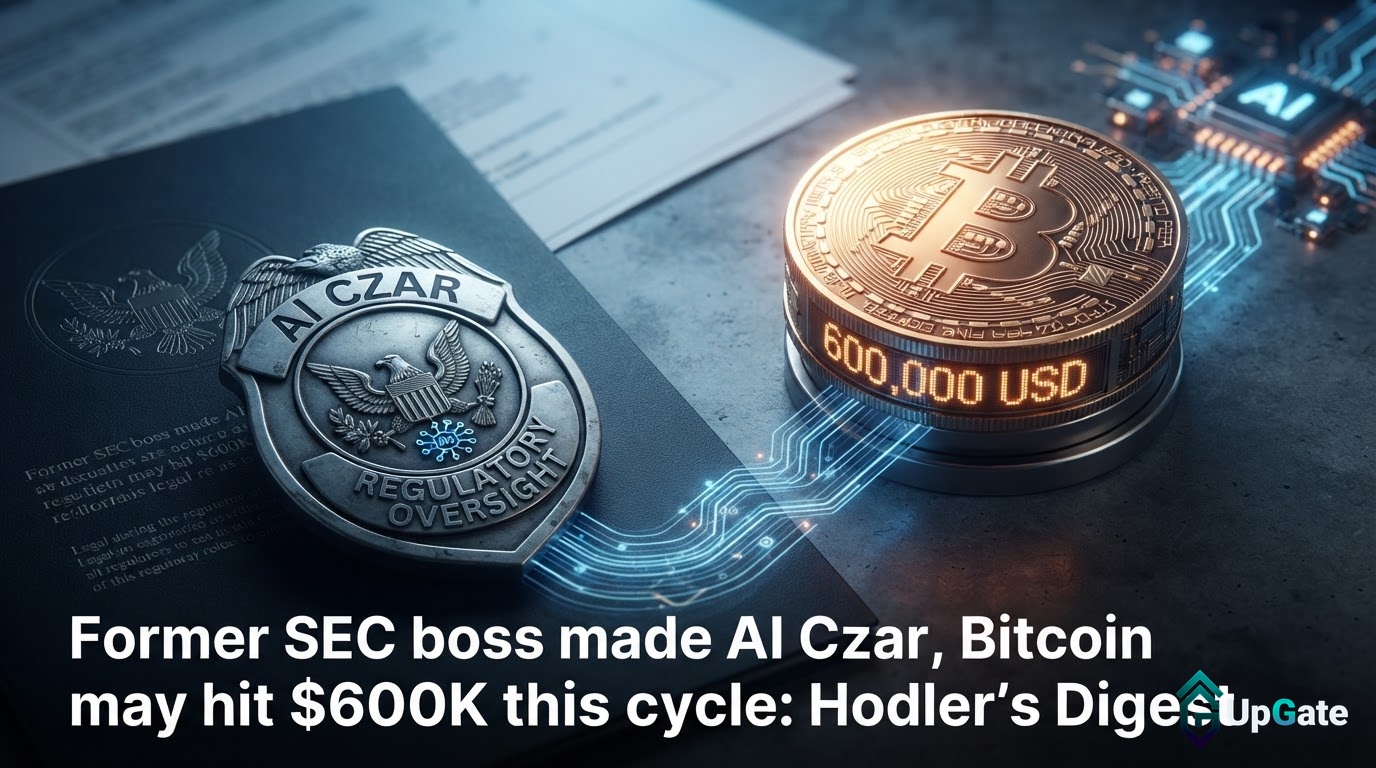
Trump Appoints Former SEC Chair Jay Clayton as AI Czar, Sparking Crypto Backlash
President Donald Trump has appointed former Securities and Exchange Commission (SEC) Chair Jay Clayton to lead the nation’s new “Super Intelligence Force,” a move that has drawn sharp criticism from figures within the cryptocurrency community, including Roman Storm and the XRP army. The announcement, made via Truth Social on Sunday, follows media reports from Friday indicating Trump’s intention to establish an “AI Force” modeled after the Space Force.
Trump stated in his post that the Super Intelligence Force will be responsible for “coordinating the effort of the Federal Government to ensure that America continues to lead the World in Super Intelligence.” Clayton, who served as SEC Chair during Trump’s first term, initiated legal action against Ripple on his final day in office. He also led the criminal trial against Roman Storm for his alleged involvement in Tornado Cash during his tenure as U.S. Attorney for the Southern District of New York.
Roman Storm, a defendant in the Tornado Cash case, commented on the development, suggesting that “Trump’s good buddy Elon Musk is renaming SpaceXAI to SpaceXSI to honor the President’s directive renaming ‘artificial intelligence’ to ‘superintelligence.'”
NEAR Protocol’s SHIELD AI System Blocks Hacked Funds, Ignites Decentralization Debate
The NEAR Protocol has experienced a significant surge in positive sentiment, with its price more than doubling in the past month. This week, its SHIELD AI system garnered both praise and criticism for blocking Bitget’s hacked funds from its INTENTS cross-chain swap platform.
The system also played a role in halting a $3.8 million exploit of NEAR Intents, attributed to a “bug in the Omni deposit and withdrawal infrastructure interaction with NEAR Intents smart contract.” While sentiment briefly turned bearish, NEAR Intents General Manager Alex Shevchenko announced the identification of the perpetrator and issued a 48-hour ultimatum for the funds to be returned. The funds were subsequently returned, and Shevchenko advised potential exploiters to utilize bug bounties rather than disrupting services.
However, the decision to block the stolen funds has sparked controversy, contrasting with THORChain’s stance of refusing to block swaps on its platform, citing ideals of decentralization. A debate is also underway regarding whether SHIELD’s action of blocking funds could render it legally liable for future platform incidents. NEAR is down 11% this week.
Arthur Hayes Predicts “Money Printing” Amidst AI Revolution and Global Financial Stress
Arthur Hayes, Chief Investment Officer at Maelstrom fund, has predicted a surge in money printing driven by the AI revolution, the United States’ debt crisis, and escalating financial pressures in France. Speaking at a fireside chat at CONNECT by Cointelegraph: Seoul Edition during Korea Blockchain Week, Hayes highlighted the immense capital requirements for AI companies to finance data centers, even as service prices decline.
“They’ve not really given themselves a lot of options other than print money and make it less bad,” Hayes stated. He also pointed to potential monetary stimulus from China and increasing financial stress in France, citing credit-default swaps tied to BNP Paribas and widening French government bond spreads.
Ethereum Layer-2 Network Blast Ceases Operations Due to Unsustainable Economics
The Ethereum layer-2 network Blast has announced its shutdown, citing that its operating costs have surpassed its revenue generation. In a post on X, Blast stated that it sees “no credible path” to achieving economic sustainability and has advised users to withdraw their assets to the Ethereum mainnet.
“We launched Blast with the goal of building a self-sustaining chain for users and developers,” the team explained. “Unfortunately, the economics of operating the chain no longer make sense.” Founded in November 2023 by Tieshun “Pacman” Roquerre, founder of NFT marketplace Blur, Blast offered native yield on Ether (ETH) and stablecoins, along with a points program for an anticipated token airdrop. This strategy attracted over $2 billion in deposits before its mainnet launch in February 2024. However, its total value locked in decentralized finance (DeFi) has fallen by over 98% from its peak in June 2024, according to DeFiLlama data.
Ethereum’s Glamsterdam Upgrade Set for Sepolia Testnet Activation
Ethereum developers have scheduled the network’s next major upgrade, codenamed “Glamsterdam,” to activate on the Sepolia testnet on October 6. Sepolia node operators are required to update both their execution-layer and consensus-layer clients prior to the activation, according to the Ethereum Foundation.
Key changes in Glamsterdam include enshrined proposer-builder separation, which will integrate the handoff between specialized block builders and validators directly into Ethereum’s protocol, reducing reliance on external middleware. The upgrade will also introduce block-level access lists, recording account and storage usage for each block, and enable parallel processing by clients to enhance throughput.
Market Update: Bitcoin Hovers Near $86K, Altcoin Performance Mixed
At the close of the week, Bitcoin (BTC) has seen a 1.4% increase, trading at $85,821. Ethereum (ETH) is up 0.6% to $2,701, while XRP (XRP) has declined 0.8% to $1.50. The total cryptocurrency market capitalization stands at $2.92 trillion, according to CoinMarketCap.
Among the top 100 cryptocurrencies, the leading altcoin gainers this week are Midnight (NIGHT) with a 60.6% increase, StarkNet (SRK) up 14.5%, and Pump.fun (PUMP) with a 26.3% rise. Conversely, the top altcoin losers include Lighter (LIT), down 22.2%, Zcash (SEC), down 16.4%, and Ethena (ENA), down 14%.
Peter Brandt Turns Bullish on Bitcoin, Predicts $600K Peak by 2029
Veteran trader Peter Brandt has adopted a bullish outlook on Bitcoin, a shift from his July warning of potential price drops into the high $40,000s. “There’s a good possibility we have seen the low and now are entering a new bull market cycle in Bitcoin,” Brandt stated in the latest episode of Trade Secrets.
Brandt has also revised his forecast for Bitcoin’s next peak, now anticipating a high between $300,000 and $600,000 by late 2029, an upward revision from his previous projection of $250,000 to $300,000. He believes the current bull market cycle has a strong chance of reaching half a million dollars.
September Sees Record Crypto Hacks, Exceeding $766 Million in Losses
September marked the worst month of the year for cryptocurrency hacks and exploits, with two blockchain security firms estimating total losses at over $766 million. PeckShield reported 55 major incidents resulting in $766.5 million in stolen funds, while CertiK recorded 97 incidents with estimated losses of $768.4 million.
Notable incidents in September included the $388 million Bitget hack and a $320 million hack of the Liquid Network. Reports indicate that over $270 million was subsequently recovered. “September was a stark reminder of how quickly the threat landscape can shift,” CertiK commented. Other significant hacks during the month affected Safe Wallet ($7.8 million), DCENT ($6 million), and Duelbits ($5.9 million).
Aave v3 Unaffected by Third-Party Exploit; Tether Freezes $550M in Iran-Linked USDT
Aave founder Stani Kulechov clarified that Aave v3 was not impacted by an exploit that drained approximately $305,000 from two Safe multisig wallets. The exploit targeted a third-party adapter built on top of the lending protocol. “This is not Aave v3 contract, it’s third party external adapter built on top of Aave, zero effect on Aave v3,” Kulechov stated on X.
In separate news, stablecoin issuer Tether announced its role in assisting authorities to freeze nearly $550 million in Iran-linked USDT. The company reported working closely with international law enforcement for years, freezing over $130 million in USDT across four wallets this year alone, including over $344 million linked to the Central Bank of Iran in April. Tether’s statement comes as a Senate subcommittee report alleged that USDT has become a primary channel for Iran to evade sanctions, with 84% of sanctioned Iran-linked crypto wallets transacting exclusively or nearly exclusively in USDT. This prompted U.S. Senator Richard Blumenthal to call for investigations into potential sanctions violations by the Treasury and Justice departments.
THORChain’s Refusal to Block Bitget Hack Funds Fuels Decentralization Debate
The ongoing debate surrounding Bitget’s $387.7 million in hacked funds centers on the core principle of whether “permissionless and decentralized” technology necessitates an absolute refusal to intervene, even when intervention is possible. THORChain has stated it will not, or cannot, block addresses linked to the $387.5 million Bitget hack. Crypto lawyer Yuriy Brisov commented on the complexity of whether developers could face prosecution for money laundering in such scenarios. The rapid settlement capabilities of stablecoins, which can move across borders at high speeds, present both risks and opportunities, depending on one’s perspective.