S&P Maintains 'Weak' Rating for USDT Stability Amidst Market Price Discount
Published
S&P Global Ratings has reaffirmed its lowest possible rating for Tether's (USDT) dollar peg stability, maintaining a 'weak' assessment with a score of 5 out of 5.
MissedBlock Desk · 3 min read
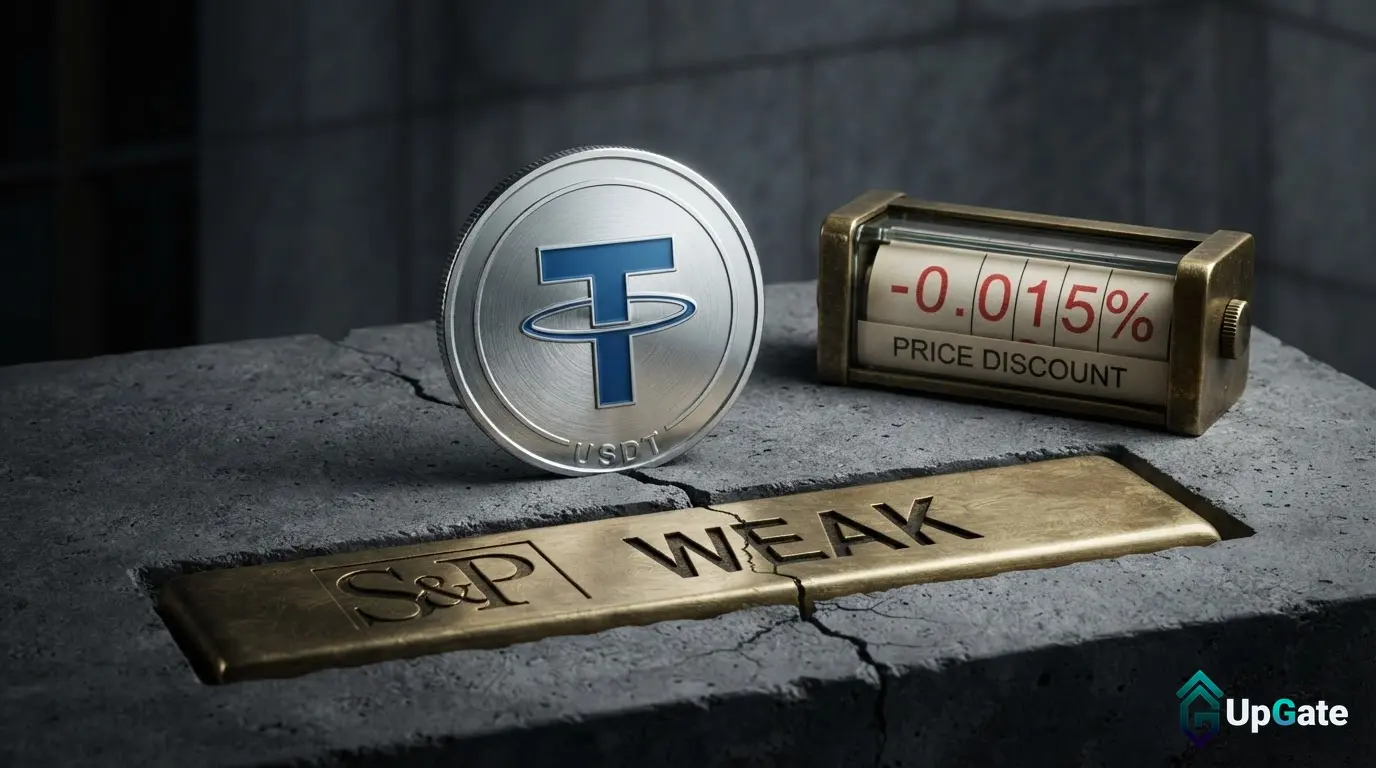
S&P Global Ratings has reaffirmed its lowest possible rating for Tether’s (USDT) dollar peg stability, maintaining a ‘weak’ assessment with a score of 5 out of 5. This unchanged rating comes as USDT experienced a discount against USD Coin (USDC) on the Binance exchange.
On November 21, USDT traded at a discount to USDC on Binance. Around 7:25 AM Taipei time, the USDC/USDT pair reached 1.0023, indicating that 1 USDT was valued at approximately 0.99771 USDC, a discount of about 0.23%. By 11:35 AM Taipei time, the discount narrowed to approximately 0.16%, with the pair trading at 1.00163.
These price deviations reflect market trading prices between the stablecoins and do not suggest a directional shift or a specific magnitude of decline against the US dollar. However, the relative price difference has drawn renewed attention to the reserves and redemption mechanisms of these stablecoins.
S&P Global Ratings’ assessment, updated as of November 18, continues to place USDT in the lowest tier of its 5-point scale. According to S&P’s analysis, concerns persist regarding the composition of assets backing USDT and operational transparency.
Reserve Composition and S&P’s Concerns
As of the end of September, S&P reported that higher-risk assets—including gold, Bitcoin, stocks, loans, and corporate bonds—represented 28% of circulating USDT, an increase from 24% a year prior. S&P’s assessment indicates that significant declines in these assets could weaken the coverage of token liabilities. The agency also identified reserve segregation arrangements, custodians, and counterparties as ongoing weak points.
Tether’s Response and Financial Overview
In contrast, Tether reported that its Q3 reserves showed assets exceeding liabilities by approximately $7.955 billion. Tether stated that the discrepancy lies with S&P’s assessment framework, not its reserves, and emphasized that its holdings in US Treasury bills and other assets provide a sufficient buffer. The company’s Q3 report indicated total assets of $1.900 trillion, including $1.300 trillion in US Treasury holdings.
S&P’s evaluation methodology prioritizes the volatility of high-risk assets, redemption capabilities under stress, and disclosure levels. The persistence of the ‘weak’ rating suggests that S&P’s concerns regarding these factors remain, regardless of Tether’s reported financial performance and asset coverage.
The market price discrepancy between USDT and USDC, alongside S&P’s unchanged ‘weak’ rating, highlights the ongoing scrutiny of stablecoin stability. While market prices fluctuate based on liquidity and trading dynamics, external ratings offer a longer-term perspective on perceived risk and operational robustness. The differing viewpoints between Tether and S&P underscore the complexities in assessing stablecoin stability and the varied methodologies employed.
Why This Matters
The materials describe a narrow update: USDT traded at a discount to USDC on Binance, reaching approximately 0.23% at its peak. The exact impact of potential declines in higher-risk assets on USDT’s stability remains uncertain.
Broader Context
Source materials place the factual news in this context: USDT/USDC discount on Binance.