TCG Blockchain Turns Childhood Cards into High-Stakes Gambling
MissedBlock Desk · · 14 min read
Updated
Trading Cards on the Blockchain: From Childhood Collectibles to a High-Stakes Digital Casino
A single Pokémon card is sold an average of eight times per month on the Courtyard platform, which has seen its monthly sales skyrocket from $449,000 to $66 million in just one year. The blockchain is transforming the trading card game (TCG) industry into a streamlined process of opening packs, buybacks, and resales, potentially multiplying inventory turnover by up to 100 times. Childhood collections are rapidly evolving into a new generation’s high-stakes gamble for quick riches.
The Blockchain’s Impact on Card Trading
While seemingly a simple digitization of trading cards, the integration of TCGs with blockchain technology has created a high-speed circulation machine that compresses the processes of “opening packs, buybacks, and resales” onto a single card. On Courtyard, a single card can change hands an average of eight times per month. This has fueled an explosive growth in platform sales, surging from $449,000 in April 2024 to $66 million in April 2025. As childhood collectibles become infinitely tradable inventory, the moment young people feel closest to striking it rich might also be the moment they are closest to a casino floor.
A New Marketplace for Digital Ownership
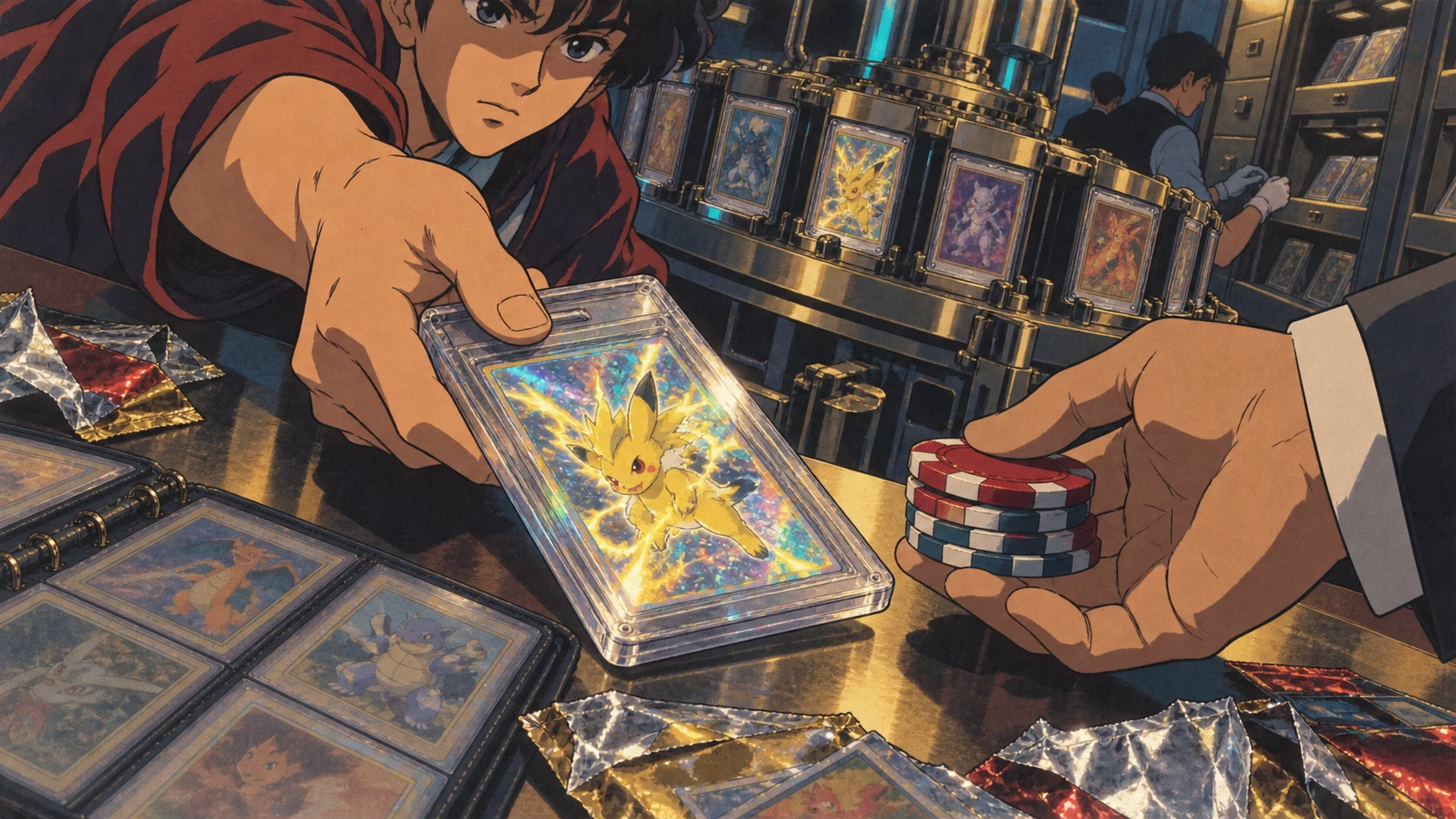
On Courtyard’s product pages, players are presented with several options: opening a random pack, storing the drawn card in a digital vault, requesting physical delivery, or accepting the platform’s offer for immediate cash-out.
A Pokémon card, sealed in a transparent hard case, can thus have multiple destinations. For one person, it represents an exit strategy after failing to pull a desired card. For another, it might be the missing piece in their collection. When a trade occurs, the physical card remains in place; what changes is ownership and the willingness of someone to pay for it.
This is where the most significant shift lies for trading card games that have moved onto the blockchain. Previously, once a pack was sold, the operator would await the next customer. Now, opening packs, making offers, buybacks, and subsequent purchases can be seamlessly connected. The same card, with the same budget, can participate in multiple transactions consecutively. Inventory stays put, while trading volume grows exponentially.
The Allure of the Gamble
Humans are inherently drawn to gambling, meaning a portion of people are willing to spend small amounts for a chance at a significant outcome. But where do they place their bets? Some invest in widespread advertising, others in endorsements from influencers, and some choose familiar cultural IPs. TCGs have emerged as a powerful vehicle for this.
Rather than betting on incomprehensible slot machines in a casino, why not buy a Pokémon card you recognize? The appeal is simple: “I know Pokémon.”
A Booming Market
As of the end of March 2026, over 85 billion Pokémon cards have been produced, with sales spanning more than 90 countries and regions. The digital card application, Pokémon TCG Pocket, announced in October 2025 that it had surpassed 150 million cumulative downloads.
A report updated in October 2026 by research firm Straits Research projected the global trading card game market size to be approximately $16.3 billion that year.
In December 2025, Business Insider, citing eBay data, reported that trading cards were the most purchased second-hand item category by Gen Z on the platform up to that point.
A Rich History, A New Frontier
TCGs have a history far longer than cryptocurrencies. In 1993, Magic: The Gathering was released. Wizards of the Coast co-founder Peter Adkison traveled along the U.S. West Coast, visiting game stores and introducing players to the new gameplay of buying cards, building decks, and battling through demonstrations. This led to the proliferation of small, independent game shops. These seemingly modest establishments served not only as sales channels but also as social hubs for fans.
Thirty years later, the elementary school students who once bought cards now possess significant purchasing power. Cards have transitioned from mere game components to collectibles and investment assets. Some players focus on deck strategy, others pursue specific illustrations and editions, and some buy back the “white moonlight” cards they couldn’t afford in their youth. Regardless of the motivation, the target audience continues to expand.
Hasbro’s 2025 investor data indicates that the average Magic: The Gathering tabletop player is around 35 years old and has been playing for over five years. The Wizards Play Network encompasses approximately 9,600 stores. In 2025, combined revenue from Magic: The Gathering tabletop and digital products reached $1.72 billion, a year-over-year increase of 59%.
The Search for Financial Mobility
Perhaps the most direct reason for this shift is the diminishing hope for upward economic mobility among young people.
The barriers to traditional wealth accumulation are becoming increasingly high. A 2025 survey by the National Association of Realtors in the U.S. showed that first-time homebuyers accounted for only 21% of all homebuyers, with the median age for first-time homeownership rising to 40. A 2026 survey by Northwestern Mutual found that among U.S. Gen Z respondents who use or consider high-risk speculative tools, 80% reported feeling financially behind and hoped these tools (aka TCGs/Crypto) would help them achieve their goals faster.
This data paints a picture of two coexisting realities: large assets require long-term accumulation, while small-ticket, immediate products with the potential for high returns are capturing a segment of the population’s attention.
Familiarity Breeds Engagement
Trading cards also offer an entry point through cultural familiarity. An individual might not understand a company’s cash flow but knows which character or version is popular within the community. While familiarity doesn’t guarantee profit, it makes participation more accessible. Even if prices don’t immediately rise, the act of collecting and displaying can provide a reason to hold onto cards, fostering a sense of being more knowledgeable than older generations.
A 2025 study on Australian collectibles commissioned by eBay and conducted by Deloitte found that 35% of surveyed collectors view their collections as good investments. Among those collecting for investment purposes, 40% expected returns exceeding 50%. eBay data cited in the report also showed that the One Piece OP-01 booster box has seen its transaction price increase by 200% since 2022. Such stories are undeniably appealing, easily transforming a hobby into an investment attempt.
The prospect of buying back childhood favorites while also seeing assets appreciate is a compelling proposition.
The Blurring Lines Between Consumption and Investment
The line between spending on cards as consumption versus investment is so blurred that even buyers may not strictly differentiate.
A beloved character provides a reason to buy, a rare version offers a reason to hold, and the success stories of others create the imagination of future appreciation. This narrative spreads rapidly, from one person to hundreds.
Accelerating Transactions: The Need for Speed
But is this enough? Holding physical cards can be slow. Cards, being non-standardized items (similar to NFTs), are difficult to price uniformly, which limits trading volume, turnover rates, and liquidity, thus hindering the development of a derivatives market. Consequently, to stimulate “spot” trading and the “get rich quick” effect, merchants incorporate “blind box” and “card-pull” probability games into their sales.
Cards thus offer two distinct avenues for potential gains: buying a single card and waiting for its value to increase from $100 to $300, or spending tens of dollars to pull a card worth significantly more. The former relies on the next buyer increasing their offer, while the latter depends on the luck of the draw. However, the traditional model’s processes are either too slow or opaque, making them difficult to scale.
Streamlining the Process: From Physical to Digital
To accommodate more participants at this trading table, the issue of repeatedly moving a single card needs to be addressed.
Traditional card sales involve taking photos, confirming condition, packaging, and shipping. Cross-border transactions also incur customs and taxes. According to eBay U.S. fee schedules, for the first $7,500 of the total transaction value per item, the final value fee is 13.25%, plus a per-order fee. Assuming a $100 order with no taxes or shipping, after deducting the 13.25% fee and a $0.40 order fee, the seller receives $86.35.
Under this cost structure, a 10% price increase from $100 to $110 might not be worth realizing a profit, as the “wear and tear” of the card market, including potential condition risks from handling, may not even cover the costs.
Centralized Custody and Blockchain Integration
This is where companies like Fanatics Collect have adopted a centralized custody model, separating physical movement from trading. Once cards are in the vault, they can change owners multiple times until someone requests physical delivery. This significantly addresses efficiency issues.
However, this is still not fast enough and doesn’t fully resolve ownership issues.
On-chain credentials offer another layer of possibility. When permitted, these credentials can be transferred to external wallets for use in other trading markets and smart contracts, with payments potentially linked to stablecoins. Custody solves the problem of cards not needing to be repeatedly moved, while blockchain integration expands the circulation of these credentials and the services that can interact with them.
The Keys to Success: Price Discovery and Turnover Rate
Understanding this business hinges on price discovery and turnover rate.
A card listed at $100 with a platform valuation of $100 does not necessarily mean someone is willing to pay $100 right now. The listing price reflects the seller’s expectation, the transaction price records past sales, and the bid price indicates how much a holder can exit with at that moment. The more independent buyers there are, and the more robust the bidding and transactions, the easier it is for collectors to decide whether to hold or sell.
The turnover rate determines another crucial factor: how many transactions a given inventory can participate in. If inventory is valued at $1 million and prices and inventory size remain constant, a monthly turnover corresponds to $1 million in sales. Ten turnovers per month correspond to $10 million. If the original turnover was once every ten months, increasing to ten times per month would result in a 100-fold increase in sales volume.
Nico Le Jeune, founder of Courtyard, stated that a single card is sold an average of eight times per month on the platform. Sporting Crypto, compiling data from CryptoSlam, reported that platform monthly sales grew from approximately $449,000 in April 2024 to about $66 million in April 2025. This expansion from a small base by a collectibles platform demonstrates the potential when trading frequency and distribution scope increase together.
The Mechanics of the New “Casino”
Within this system, random card packs and instant buybacks further accelerate turnover. If a user pulls a card they don’t like, they don’t have to wait for someone else to buy it; they can accept the platform’s offer and convert the outcome into balance. The platform then reclaims the inventory and continues organizing sales.
From the perspective of random rewards and redemption mechanisms, this resembles a new casino disguised with an IP facade. However, whether operators can profit depends on the probabilities of the entire pool of cards, costs, and cash reserves, not just the buyback discount.
A Simplified Financial Model
Let’s assume a user spends $50 to pull a card valued at $100 and then sells it back to the platform for $85. After the complete cycle, the card returns to the platform, and the cash change for the platform is: $50 – $85 = -$35.
To illustrate: if a pack costs $50, the weighted average estimated value of cards is $45, and the buyback rate is 85%. If all cards are immediately sold back, and probabilities and valuations remain constant, the average buyback expenditure per round would be $38.25, leaving an average of $11.75 in cash (simplified calculation, excluding any costs).
$11.75 = $5 difference between sale price and average valuation, plus $6.75 in buyback based on the $45 valuation.
The amount of funds returned to the user determines whether they can continue for the next round. In the above model, the average return rate is 76.5%. If we further assume that funds can be infinitely divided, the return rate is constant, and the entire balance is reinvested with no minimum purchase amount, then the theoretical cumulative purchase amount supported by an initial budget of $50 would be: $50 / (1 – 76.5%) = $212.77.
Real products have pack denomination limits, and pull results will fluctuate. If each pack is fixed at $50, after receiving $38.25, the user would need to add funds or purchase cheaper products.
The Real-World Complexity
In reality, it’s not this simple. Users don’t sell every card back. Some keep desired cards, some request physical delivery, and others seek higher offers on the secondary market. Even if a card doesn’t leave the warehouse, as long as it belongs to a user, it’s no longer inventory that the platform can freely return to the prize pool. The platform needs to procure new cards to maintain the appeal of the prize pool and manage buyback expenditures when high-value outcomes occur.
Courtyard’s Fee Structure
Courtyard’s fee arrangements reflect the differences in various business models:
- Peer-to-peer (P2P) secondary trading platform fees are zero.
- Card pull buyback offers have a seven-day acceptance window, with valuations referencing recent transactions, market trends, and grading differences.
- A 6% fee is charged for transfers triggered by accepting a card pull buyback, while ordinary market transactions incur no such fee.
Therefore, TCG platforms operate as both trading markets and bear the inventory risk of buyback offers.
A Parallel to Perpetual Futures
This bears a notable resemblance to perpetual futures contracts: the same product is used to reduce trading friction and accommodate different participation motivations. In the perpetual market, some bet on direction, some hedge, some earn funding rates, and some act as market makers. In the card market, some chase IPs, some collect (hoard) for value, some engage in lucky draws, some play games, some seek price differentials, and some manage inventory.
Connecting Worlds
More than thirty years ago, Magic: The Gathering brought people together through game stores. Today, card platforms are attempting to unite dispersed individuals with diverse objectives around the same physical inventory. Culture introduces them to what’s on the table, mechanics enable faster and more efficient transactions, and custody and settlement eliminate the need to wait for a shipment for the next round.
Some are willing to spend small amounts for a chance to change their outcome; others are willing to spend a certain amount to acquire their desired outcome. Connecting these two groups is the most promising business for TCGs on the blockchain.
The Sustainability Question
Whether a platform can consistently achieve several key objectives—a steady supply of goods, randomness/fairness, continuous buybacks, and competitive offers—will determine how long and how large this trading table can remain, far more than how many times a card is handled in a vault.
A Heartwarming Tale of Jirachi
If you’ve heard of Pokémon before, allow me to introduce another creature from the series: Jirachi, the Wish Pokémon, and a touching story behind it.
A young boy named Avery, who endured the rigors of cancer treatment from the age of four, found solace in Pokémon cards during his difficult journey. His favorite card was Jirachi, but he was never fortunate enough to pull it.
As he neared the end of his life, he finally pulled a Jirachi.
The boy on screen stood stunned, exclaiming repeatedly, “I can’t believe it…”
This video became his final card-opening record. Shortly thereafter, having endured the long and arduous treatment, he peacefully passed away.
During the long and cold months of chemotherapy, it was these cards that provided him with the strength to persevere. In this world of hype, speculation, rarity, and investment returns, this twelve-year-old boy taught us:
“What truly moves people is not the price or the rarity of a card, but the beauty that comes from the depths of your heart, the one you are willing to cherish for a lifetime.”
Legend has it that Jirachi sleeps for a thousand years, awakening for only seven days, and can only be roused by a clear and pure voice. May you who are reading this always maintain that pure passion.
Because of purity, there is hope.