Trump Hints at US Government Stake in AI Firms
MissedBlock Desk · · 5 min read
Updated
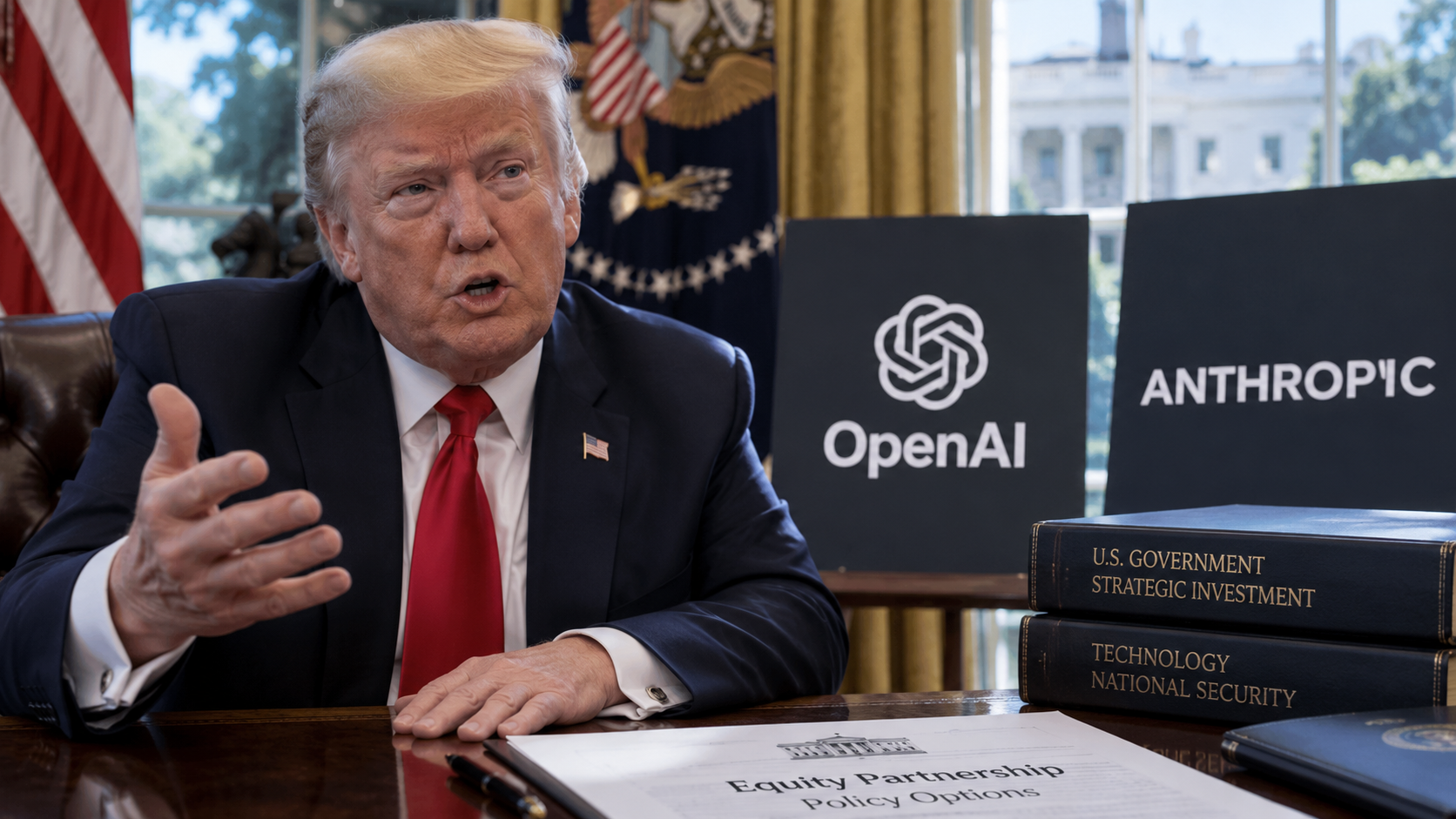
Trump Hints at Potential Stake in AI Firm Anthropic
In a recent interview with TIME magazine, former President Donald Trump expressed admiration for Anthropic CEO Dario Amodei. When questioned about the possibility of the U.S. government taking a stake in Anthropic, similar to its investment in Intel, Trump responded with a suggestive, “Maybe I could do that.”
Background: A Shifting Relationship
The U.S. Department of Defense initially flagged Anthropic as a supply chain risk in March, a designation upheld by a federal appeals court on September 25th. However, just two days later, Amodei was seen dining with Trump at the White House for over two hours.
The following day, in an interview with TIME published on October 1st, Trump spoke favorably of Amodei and his wife, noting that the CEO’s views differed significantly from media portrayals and describing him as “very smart.” Despite his positive personal assessment, Trump remained firm on regulatory matters, stating, “If you go for regulation, they can shut you down.” He justified this stance by emphasizing America’s current global lead in AI and his desire to maintain that advantage.
Trump definitively ruled out nationalizing top AI labs, stating, “No, I won’t.” He explained that existing safeguards, such as the Department of Justice and FBI, served as sufficient checks, having been utilized effectively twice before. This approach suggests a preference for post-incident enforcement rather than preemptive regulation.
Amodei’s AI Safety Stance and a Voluntary Agreement
Regarding OpenAI’s Sam Altman, Trump was candid, saying, “I like him. Trust? Who can I trust?” Notably, the day after the TIME interview, Amodei returned to the White House to sign a voluntary AI safety agreement alongside representatives from Google, Meta, OpenAI, Nvidia, and xAI.
TIME reported that officials described the agreement as a mutual understanding to avoid surprising each other with adverse developments. This move by Amodei, who had recently advocated for slowing the development of frontier AI models, signifies a commitment to self-regulation over government oversight.
The Intel Precedent: A Model for Investment
Trump characterized the Intel deal as straightforward: Intel had a problem he could solve, and in exchange for his assistance, the U.S. would receive a 10% stake in the company. He emphasized that this was not a purchase but rather an acquisition of equity.
The actual transaction involved the U.S. government subscribing to approximately 433 million new shares of Intel at $20.47 per share, totaling $8.9 billion, representing a nearly 10% stake. This investment was funded not by new cash but by reallocating $5.7 billion in previously approved but unallocated CHIPS Act subsidies and $3.2 billion from the Secure Enclave program.
Trump claimed this deal generated “sixty to seventy billion dollars” for the U.S. Based on Intel’s closing price of around $120 on October 1st, the 433 million shares would be valued at approximately $52 billion, yielding a paper profit of roughly $43 billion after accounting for the $8.9 billion cost.
A Pattern of Strategic Equity Acquisition
Trump indicated this strategy was not a one-off. He mentioned a situation involving Nvidia, where a chip prohibited from sale could be offered with a U.S. government cut, though he did not specify the percentage. He also cited a land development project in Alaska where he demanded a 50% stake for the U.S., which was agreed upon. His conclusion was, “I’ve always done it this way, not for myself, but for the country.”
The underlying formula appears to be: the government holds approval power, the other party has an unresolved issue, and the exchange is equity or a revenue share.
Applying the Intel Model to Anthropic
If the Intel model were to be applied to Anthropic, the key question becomes: what is Anthropic’s “unresolved issue”? The most apparent answer is the supply chain risk designation, stemming from Anthropic’s refusal to allow its AI, Claude, to be used for autonomous weapons or mass surveillance of Americans. The majority opinion on the appeals court came from Judge Gregory Katsas, with Karen LeCraft Henderson dissenting. Anthropic has stated it is considering all options, including further review.
This suggests that the supply chain risk designation could serve as leverage for the White House if it seeks to replicate the Intel model. However, there is currently no indication of negotiations, and Trump’s statement remains a tentative “maybe.”
The Scale of Potential Investment and Market Dynamics
The primary difference lies in the magnitude of the stakes. Bloomberg reports that Anthropic is seeking to conduct a roadshow in mid-November and list before Thanksgiving, with a target valuation of approximately $2 trillion and a potential fundraising of up to $100 billion. Its post-money valuation in a May funding round was $965 billion.
A 10% stake, mirroring the Intel deal, would represent an equity value in the $200 billion range, more than twenty times the $8.9 billion Intel investment. Unlike Intel, which needed its stalled subsidies to be realized, Anthropic is in a position to attract significant investor interest for its IPO. This disparity in negotiation leverage is substantial.
Public Opinion and the Dual Nature of Investment
Public sentiment also presents a challenge. TIME journalists presented Trump with data showing 71% of Americans oppose building data centers and 57% believe AI is more harmful than beneficial. When asked about potential public resistance, Trump admitted, “I might not be able to.” With the midterm elections just a month away, internal polling from his own pollster, Tony Fabrizio, indicates widespread public anxiety.
Government investment in AI companies thus presents a double-edged sword. For voters, the narrative of sharing in AI’s economic gains is appealing, a point echoed in policy papers by OpenAI and Anthropic themselves, which advocate for broad public participation in AI-driven growth. However, from a regulatory perspective, government ownership blurs the lines between regulator and participant.