US Stocks Shed $6 Trillion in 45 Days: AI Bubble Burst?
Published
Global financial markets are experiencing a suffocating wave of selling pressure.
MissedBlock Desk · 6 min read
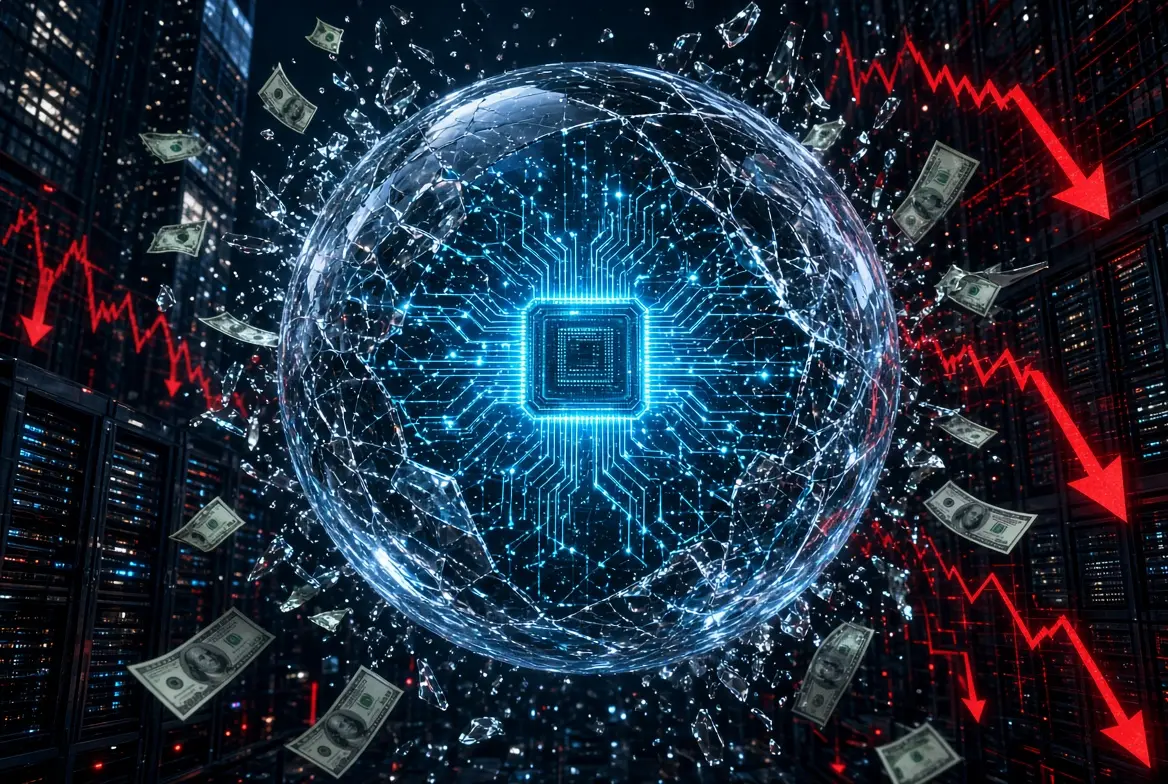
Wall Street Grapples with AI Bubble Fears as Markets Plunge
Global financial markets are experiencing a suffocating wave of selling pressure. U.S. stocks have shed an average of $225 billion in market capitalization daily for 31 consecutive trading sessions. In just 45 days since the S&P 500 last hit a record high on October 6, a staggering $6 trillion in value has evaporated, dragging down gold and cryptocurrencies in its wake. Amidst widespread doomsday sentiment, prominent macroeconomic analysis firm The Kobeissi Letter released a comprehensive analysis on November 20, directly addressing Wall Street’s most pressing anxiety: has the artificial intelligence (AI) bubble burst? The firm definitively answers no, asserting that the current downturn, one of the most severe since the inception of AI trading, is fundamentally a healthy correction driven by a confluence of political and liquidity headwinds.
Unpacking the Sell-Off Drivers
The sell-off over the past 45 days was initially triggered by investor concerns that massive AI capital expenditures by major tech companies could compress free cash flow and negatively impact profitability in the years 2027-2028. Data reveals that the four cloud giants—Amazon, Alphabet, Meta, and Microsoft—collectively increased their capital expenditures by $36.9 billion in the third quarter of 2026, reaching a record $201.9 billion. This figure has more than doubled in the past 12 months, surging 356% since the first quarter of 2024. Over the last three years, large tech enterprises have cumulatively invested a staggering $1.6 trillion in capital expenditures.
While the market generally anticipates clearer evidence of return on investment (ROI) by the first or second quarter of 2027, The Kobeissi Letter argues that these record infrastructure investments are a necessary condition for the largest technological revolution in history. The temporary dip in free cash flow is merely a transitional cost of long-term construction. In fact, S&P 500 companies have delivered robust year-over-year earnings per share (EPS) growth of 31.9% since the third quarter of 2026, the strongest performance in at least four years. Actual earnings have surpassed market expectations for 13 consecutive quarters, indicating that the fundamentals of AI infrastructure are far more resilient than Wall Street currently believes.
Political Shifts and Monetary Tightening Fuel Downturn
Beyond corporate earnings concerns, shifts in U.S. politics and monetary tightening policies have also served as significant catalysts for the tech stock pullback. The Kobeissi Letter points out that the Democratic Party’s sweep of both houses in the midterm elections effectively signaled the end of the so-called “Trump Put”—a market phenomenon where investors found comfort in the expectation of intervention to support the market during periods of significant volatility. With Democrats now controlling Congress, Trump’s ability to prop up the market has diminished. The market is also preemptively pricing in potential aggressive AI regulations or even bans that could be implemented by the Democratic administration upon its formal assumption of power in January 2027. However, the firm contends that regulatory fears are significantly overblown, as the U.S. is highly unlikely to hamstring its development or prohibit AI progress in its global race with China.
Concurrently, the macroeconomic interest rate environment remains challenging. With the Iran conflict nearing its 300th day and U.S. inflation exceeding the 2% target for 67 consecutive months, Federal Reserve Chairman Warsh has strongly reiterated that bringing inflation back to 2% is the paramount priority, with no exceptions. This exacerbates the already costly financing of AI development and intensifies pressure on U.S. federal debt. Although oil prices have fallen by approximately 22% this month, reaching their lowest point since August 2026, the hawkish stance of maintaining higher interest rates for longer is expected to persist in the short term. Nevertheless, the probability of a monetary policy pivot towards easing by mid-2027 is gradually increasing.
Individual Stock Shocks and IPO Liquidity Drain
Individual stock “black swan” events and the massive liquidity drain from the primary market have pushed market panic to a critical point. Over the past two weeks, AI computing powerhouse NVIDIA saw its stock price plummet by approximately 40% within weeks following the departure of its key figure, Jensen Huang. Competitor AMD faced a short-seller report on November 19, accusing it of allegedly smuggling chips to China. However, The Kobeissi Letter believes the market has over-priced the most pessimistic scenarios before independent investigations and conclusive evidence emerge. The forward price-to-earnings ratio for the tech sector has fallen to its lowest level since March 2020, with NVIDIA’s forward P/E ratio now at a mere 9 times, making it one of the cheapest stocks in the S&P 500. The market is not only assuming Huang will never return but is also completely disregarding NVIDIA’s revenue guidance of approximately $750 billion for fiscal year 2028, which leaves substantial room for positive upside surprises.
On another front, AI giant Anthropic’s initiation of the largest initial public offering (IPO) in history, seeking to raise over $100 billion (with institutional demand reaching $400 billion and retail demand at $100 billion, nearly eight times the initial fundraising target), has severely squeezed secondary market liquidity, directly contributing to the broad decline in stocks, gold, and cryptocurrencies this week. The Volatility Index (VIX) has surged over 100% from its October lows, with a single-day increase of the largest magnitude since February 2018 recorded on November 5. Hedge funds have also experienced their largest six-week net outflow in over a decade this month, exhibiting a typical “stampede for the exits” effect.
A Healthy Correction, Not a Bubble Burst
Looking at the broader picture, The Kobeissi Letter firmly asserts that this is not an AI bubble bursting but rather a normal and healthy market correction. Even if the S&P 500 were to fall another 10% from its current levels, it would still remain within a healthy pullback range. Investors should approach extreme panic narratives predicting a further 30% or more decline in the S&P 500 with caution. Betting on a prolonged, deep bear market in 2027 would be wagering that high interest rates, stringent regulations, capital expenditure failures, and crises at leading companies will not only materialize but also worsen.
The firm emphasizes that while it is not yet possible to definitively state that the market has bottomed out, and short-term volatility and liquidity constraints may still lead to further declines, the risk-reward ratio for high-quality tech stocks with strong balance sheets, accelerating earnings, and defensible moats is becoming increasingly attractive as significant bearish sentiment has been priced into current valuations. Once the market dust settles and liquidity returns, bargain-hunting funds are expected to flood in rapidly, similar to the post-trade war correction in April 2025. As the firm has repeatedly stressed since November 2022, the investment mantra remains: “Hold your assets, or be left behind.” In this era of disruption, objective and disciplined long-term asset holders will ultimately emerge as the winners.