Vitalik: "Not Your Chip, Not Your Private Key" for Cold Wallets; Open Source to Reveal GDS Details
Published
Ethereum co-founder Vitalik Buterin published an extensive post on November 26th, detailing the importance of open-source chip design and the necessity for transparency beyond the Verilog hardware description language.
MissedBlock Desk · 6 min read
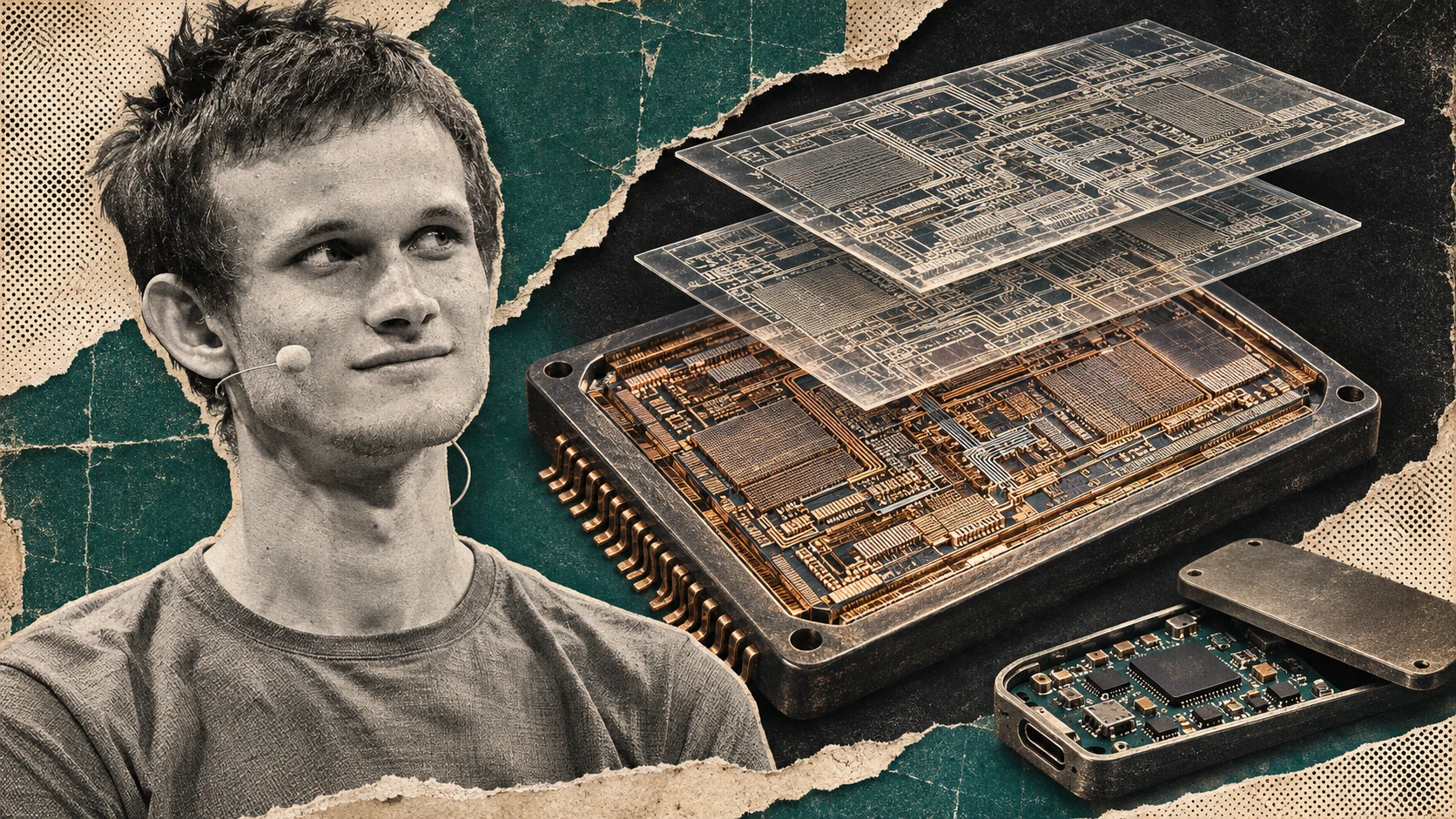
Ethereum Co-Founder Vitalik Buterin Advocates for Verifiable Hardware Design
Ethereum co-founder Vitalik Buterin published an extensive post on November 26th, detailing the importance of open-source chip design and the necessity for transparency beyond the Verilog hardware description language. Buterin argued that for actual chip verification, designs must be disclosed down to the GDS (Geometric Data Stream) physical layout level, not just Verilog, which only describes circuit logic. He highlighted the growing threat of hardware tampering, citing instances where attackers have embedded covert devices, such as eSIM-equipped spyware, into hardware wallets before they reach consumers, underscoring his new mantra: “not your silicon, not your keys.”
The Imperative of Full-Stack Openness and Verifiability
In his personal blog post, Buterin elaborated on the journey from hardware description languages like Verilog to wafer fabrication. His central thesis is that for chips to be truly verifiable, their designs must be open-sourced to the GDS level. Currently, most commercial open-source chips only disclose their Verilog code.
This call echoes the blockchain community’s 2010s slogan, “not your keys, not your coins,” which emphasized that true ownership of cryptocurrency hinges on self-custody of private keys. Buterin believes the 2020s require an extension: “not your silicon, not your keys.” He clarified that “private keys” in this context extend beyond financial assets to encompass communication and other sensitive data. For secure computation, he asserted, the hardware layer must be open and auditable.
Verilog defines the logic of a circuit. Chip design is compiled from this level into a netlist and then translated into GDS. GDS records the polygonal coordinates for each layer of metal and components, essentially defining the chip’s physical geometry.
Buterin noted that understanding his example circuit would equip individuals with the knowledge to design a leanSeal ASIC. He simultaneously shared the design for this ASIC on X, featuring a mere 240 lines of Verilog. leanSeal is a time-lock encryption proposal he developed with Quang Dao and Justin Drake, currently in its research prototype phase.
Bridging the Gap Between Logic and Physical Reality
While Verilog allows for the fabrication of functionally identical chips, Buterin explained that even with advanced microscopy, it is exceedingly difficult to reverse-engineer a physical chip and verify its Verilog code. The GDS layer, however, provides a blueprint of the chip’s intended appearance, offering a concrete basis for inspection and comparison. Achieving this level of disclosure necessitates the release of extensive manufacturing process information by foundries.
Buterin candidly described the hardware industry as highly insular. Collaborations with cutting-edge foundries often involve proprietary Process Design Kits (PDKs) and design software, requiring stringent Non-Disclosure Agreements (NDAs) for access. He characterized the current state of hardware secrecy as more severe than that of software during the peak of Microsoft Word and Internet Explorer’s dominance 25 years ago.
Emerging Open-Source Foundry Processes
Despite the general trend, some foundries are beginning to open their processes. Buterin specifically mentioned Singapore’s GF180 process, SkyWater’s SKY130 in Minnesota, and IHP’s 130nm process in Germany. Hangzhou’s ICsprout has also started offering its 55nm ICS55 process, though currently in a preview version for research and prototyping.
These open processes are generally at 55nm or larger, a significant difference from TSMC’s leading-edge 2nm technology. Buterin suggested that a more practical target for open processes is around 25nm, which, while not suitable for cutting-edge AI, is more than adequate for many other applications.
The Tangible Threat of Hardware Tampering
Buterin emphasized that these concerns are not merely theoretical. He pointed to the emergence of attackers embedding eSIM-equipped spy devices into hardware wallets before they are sold to consumers. Upon activation, these devices can exfiltrate mnemonic phrases.
He included a photograph posted by former Mt. Gox CEO Mark Karpelès on X on October 9th, showing a disassembled Ledger device with an implant beneath the main board. Ledger’s update on November 18th confirmed that the tampering incidents had expanded from Southeast Asia to Berlin and Dubai. Trezor also confirmed on November 12th that three Safe 5 devices purchased from former distributor CryptoBilis contained implants.
Buterin warned of more sophisticated future attacks, such as swapping out chips with visually identical but functionally similar alternatives that include hidden backdoors for attackers. Such substitutions would be undetectable by the naked eye.
Advanced Inspection Techniques and Their Limitations
The primary inspection technique Buterin introduced is IRIS, developed by hardware hacker bunnie (Andrew Huang). This method utilizes microscopy with different wavelengths of light to examine chips. For attackers who maintain the geometric structure but maliciously alter doping levels, more advanced techniques like FIB-SEM (Focused Ion Beam Scanning Electron Microscopy) would be necessary. This process involves sequentially deconstructing the chip for imaging and typically destroys the device.
He also cautioned that even with fully open-source hardware, consumers will not possess individual inspection machines to scan their electronics for authenticity. Such technologies are better suited for professional auditors, journalists, and civil society groups to audit manufacturers and distributors. Ledger’s current authenticity check, for instance, can only confirm if a device is genuine, not if the supply chain was compromised. In its November 18th update, Ledger began offering customers the option to send their devices to its French factory for X-ray inspection.
Buterin added that inspection techniques are most effective when paired with chip design considerations, such as enabling chips to activate only small portions of their circuitry for isolated testing or designing geometric structures that facilitate easier examination. Larger, less efficient nanometer processes are also more amenable to techniques like IRIS.
A Bifurcated Future: Performance vs. Security Hardware
Vitalik Buterin does not anticipate all hardware becoming open-source, particularly given the immense commercial pressures in high-end markets like AI. Instead, he envisions a bifurcation of the industry into “performance hardware” and “security hardware.” Security hardware might be tenfold or more less efficient but would suffice for nearly all applications. Use cases would likely begin with the Internet of Things (IoT) and expand to personal computers. He hopes that security hardware will default to being open, auditable, verifiable, and modifiable.
Understanding “Not Your Silicon, Not Your Keys”
This phrase, introduced by Vitalik Buterin on November 26th, extends the 2010s concept of “not your keys, not your coins.” Buterin posits that for secure computation, the hardware layer must be open and auditable, and private keys encompass not only financial assets but also communication and other sensitive data.
Why Verilog Alone is Insufficient for Chip Verification
Verilog describes only circuit logic, making it difficult to perform a backward comparison with an existing chip. GDS, on the other hand, records the polygonal coordinates for each layer. Buterin argues that disclosure down to this level provides a benchmark for microscopic inspection. Currently, most commercial open-source chips do not reach this GDS disclosure standard.